'The Witchcraft of Salem Village', By Shirley Jackson Book Review
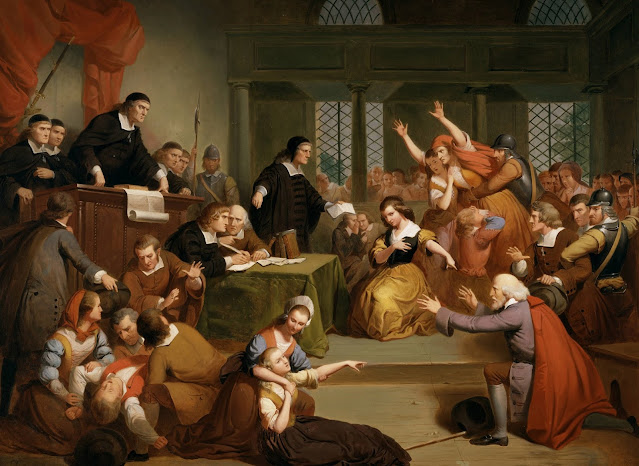
Trial of George Jacobs, Sr. for Witchcraft, 1855
Tompkins Harrison Matteson, 1813–1884, New York
This children's book was written by Shirley Jackson, THE Shirley Jackson, none other than the gothic horror writer of 'We Have Always Lived in the Castle' and 'The Haunting of Hill House', which have both been made into movies--the latter is also a mini series on Netflix! With such an illustrious author, you expect a good book, and she delivered! It is written for children, so a lot of details were left out, I got the sense she was trying not to horrify the children too much. This is a very good introduction to the subject and one thing that she excels at is bringing the reader into the story, letting you feel like you are in that courtroom, witnessing this spectacle unfold between the afflicted girls and their accused 'oppressors'.
For those unfamiliar with the story, in 1692, nine girls who lived in Salem Village, Massachusetts, were spending a lot of time with a woman who was a servant for one girl's father, the town's Puritan minister. Historical accounts differ as to whether Tituba was a slave or an indentured servant. In New England at that time, it didn't matter, you had no rights as either! In the book, she's a black woman from the West Indies, but many people are now saying that she was a Native American, from South America. When the children that she told stories to started to become ill, she was blamed for bewitching them and severely beaten by the minister to confess to her witchcraft. Two other women were also accused of witchcraft at that time, a homeless woman who begged door to door to feed her children and a woman who lived on the outskirts of town, someone who they rarely saw, as she was too ill to go to church every week. No one stood up for any of these women, all were mute at their pleading, even their husbands, who turned on them, one by one.
One thing really dramatic about these trials was that something called "spectral evidence" was admissible as evidence. What that meant is that these girls, who ranged in ages from six years old to nineteen years old were allowed to call out that they saw the people, the same people who were on trial, in another "spectral body" somewhere else, either up above them, in the rafters of the building, or among the girls, biting them or pinching them. They said they saw a yellow bird flying above them, and everyone looked up, but no bird was to be seen. People would move if the girls said someone was above them, they believed everything the girls said! A four year old child was even accused, and the girls said they were hurt by her and she was sent to prison along with her mother, who was already there, all because the pins they said she pushed into them were found in the girls. We all know now that the girls did that to themselves. Not only that, but they were allowed to go into fits and they would mock everyone who came to be interrogated. They would mimic every gesture of the hand or face, every turn of the head, and claim they could not move afterward! And in that era, they believed that to be touched by the witch that caused that, could make it go away, so there was a steady stream of these accusers coming up to the people on trial to be touched, so that they could assume another pose. One girl recanted, but she was not believed, and she had to admit that she herself was consorting with witches and had to go back to sitting with the girls who were carrying on like crazy people.
Some people now believe that the girls had gotten a batch of bad rye, and that's why they were acting so strange. But after reading this book, I find that very hard to believe. I think they did this mean stuff on purpose, because they wanted the attention and that they weren't very bright or nice at all! They didn't educate women then, and these girls took advantage of people's trusting ways. The fervor of the day over witches didn't help either. All of these factors gathered together as a perfect storm--one that destroyed Salem Village, as people left their fields to go fallow, all to witness this spectacle. To not be at the trial meant that you might have been guilty, so they were forced to be there, or possibly die! These girls got back at everyone who had every committed the slightest wrong against them, and more people than they could even know had been brought in, even some of the judges were able to get even with people they were feuding with over land and property.
I'm glad I read this book, because it's very interesting. I feel so bad for the people that had to live through this! We live in a bad time now, where many men are now being accused of crimes and not being given a chance to have a fair trial before they lose their careers. It's called 'Cancel Culture.' According to the 'Me Too' Movement, we should believe ALL women who say anything ever happened to them. No, we shouldn't! We should have the presumption of innocence. Until judges and the media stop pandering to this crowd of 'woke' people, no one is safe.
I don't watch that many movies but thanks for this
ReplyDeleteThank you for reading! This review is about a book, but there are a lot of movies about this as well.
Delete